Introduction
PET bottle filling machines are designed to perform high-speed and consistent filling operations across modern beverage and liquid-packaging lines. Their performance depends on the coordinated operation of numerous components, including filling valves, nozzles, bottle-handling parts, seals, bearings, guide components, sensors, pneumatic systems, and other precision-engineered assemblies.
Because these machines operate continuously, many of their components are subjected to repeated mechanical movement, pressure, friction, cleaning cycles, and changing operating conditions. Normal wear can gradually affect filling accuracy, bottle positioning, sealing, machine movement, and overall production efficiency. Issues such as inconsistent filling, leakage, bottle misalignment, unusual vibration, or unexpected stoppages can indicate that particular components require inspection or replacement.
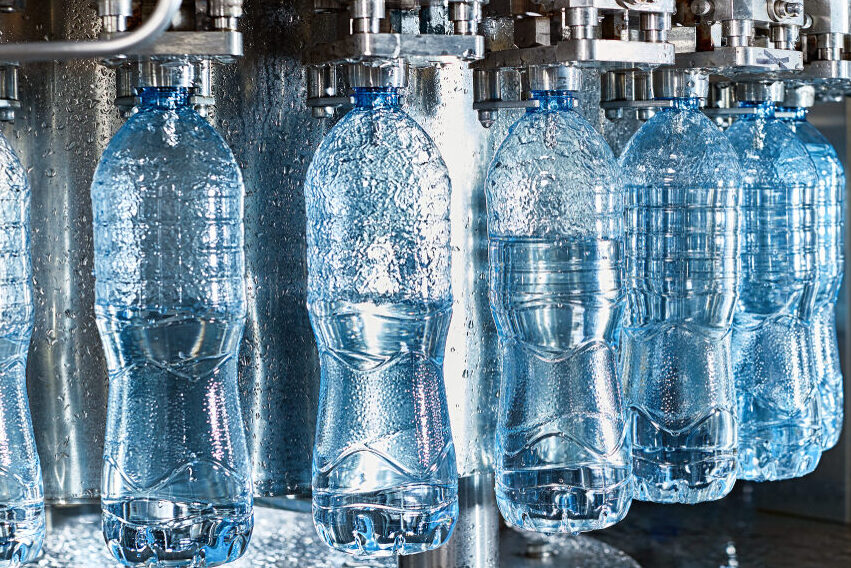
Maintaining the right PET bottle filling machine spare parts is therefore an important part of preventive maintenance. Critical spares and frequently replaced wear components can help maintenance teams respond more efficiently when a machine requires service. Industry maintenance guidance commonly separates spare parts into critical spares, wear parts, and consumables because each category has different replacement and inventory requirements.
However, choosing a replacement part should involve more than finding a component with a similar appearance. Machine model, part number, dimensions, material, application, and operating requirements should be checked to ensure the replacement is suitable for the equipment. Part identification using numbers, drawings, photographs, samples, and dimensions is also commonly used for aftermarket bottling components.
Vikram Solutions focuses on OEM-alternative spare parts for PET blowing, filling, and labelling machines, with an engineering-led approach to precision manufacturing, quality assurance, dimensional accuracy, material verification, performance validation, and traceability. The company’s website also provides part-number-based spare-parts identification and quotation support.
This guide covers the major PET bottle filling machine spare parts, their functions, common wear-related problems, replacement considerations, maintenance practices, and factors to consider when selecting the right component for your bottling operations.
- A. Filling Valves
- B. Filling Nozzles and Fill Heads
- C. O-Rings, Seals and Gaskets
- D. Bottle Grippers and Clamps
- E. Bearings and Bushings
- F. Pneumatic Components
- G. Sensors
- H. Capping Components
- I. Conveyor Components
- 1. Identify the Machine and Component
- 2. Check the Original Part Number
- 3. Verify Dimensions and Specifications
- 4. Confirm Material and Application Compatibility
- 5. Consider OEM or OEM-Alternative Options
- 6. Evaluate Supplier Quality
- 7. Consider Operating Conditions
- 9. Compare Total Value, Not Just Price
- Quick Checklist Before Ordering
- 1. Faster Replacement of Worn Components
- 2. Helps Prevent Extended Line Stoppages
- 3. Supports Preventive Maintenance
- 4. Improves Spare-Part Availability
- 5. Helps Maintain Consistent Machine Performance
- 6. Supports Better Maintenance Planning
- B2B Takeaway
- Engineering Expertise
- OEM-Alternative Spare Parts
- Quality Assurance and Warranty
- Faster Part Identification
- Structured Global Supply
- Support Across Bottling Applications
- Technical Support for Specific Requirements
- A B2B-Focused Spare-Parts Partner
What Are PET Bottle Filling Machine Spare Parts ?
PET bottle filling machine spare parts are replacement components used in PET bottle filling and bottling equipment to maintain the machine’s required performance, functionality, and operating condition. These components are designed to replace parts that become worn, damaged, contaminated, or no longer perform according to the required machine specifications.
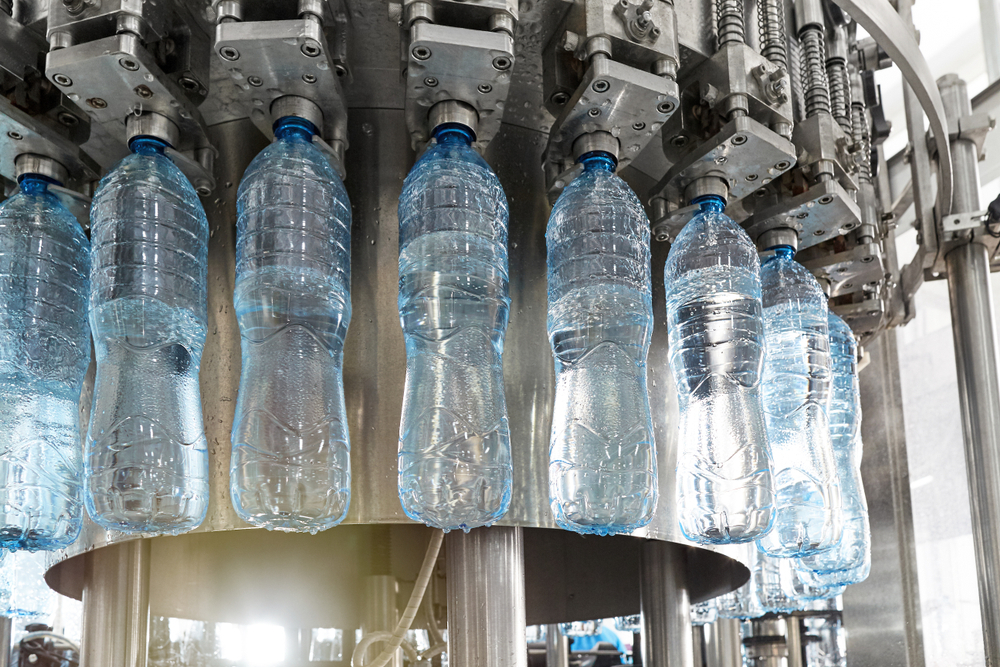
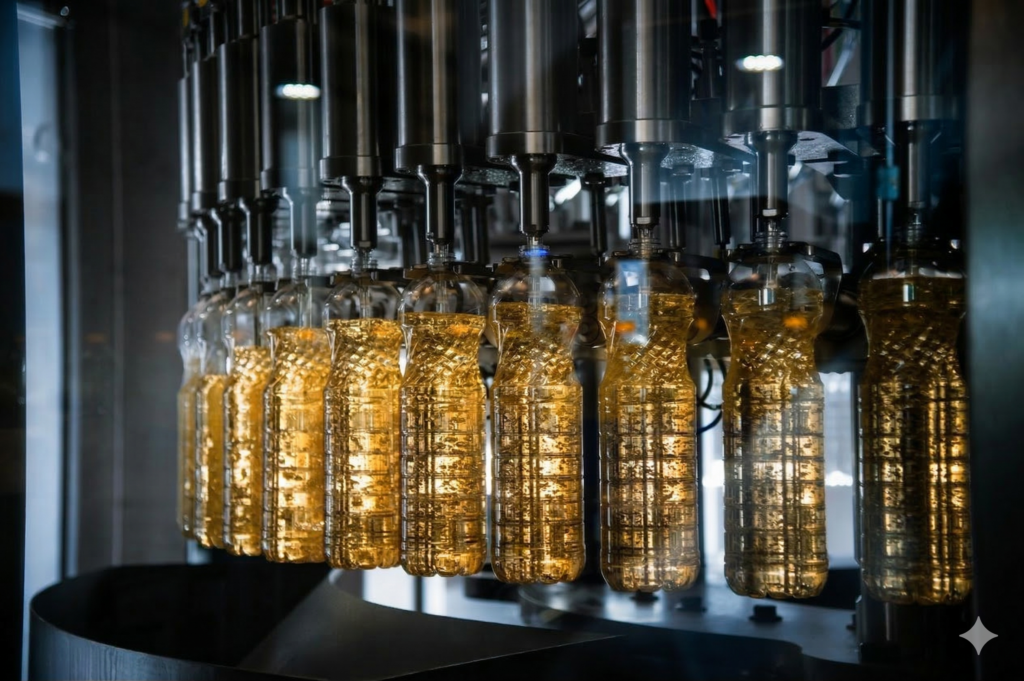
A PET bottle filling machine consists of multiple mechanical and fluid-handling components that work together during the filling process. Bottles must be accurately positioned, product flow must be controlled, and the filled bottles must be transferred to the next stage of the production line. Spare parts support these functions by maintaining the condition and performance of the individual machine assemblies.
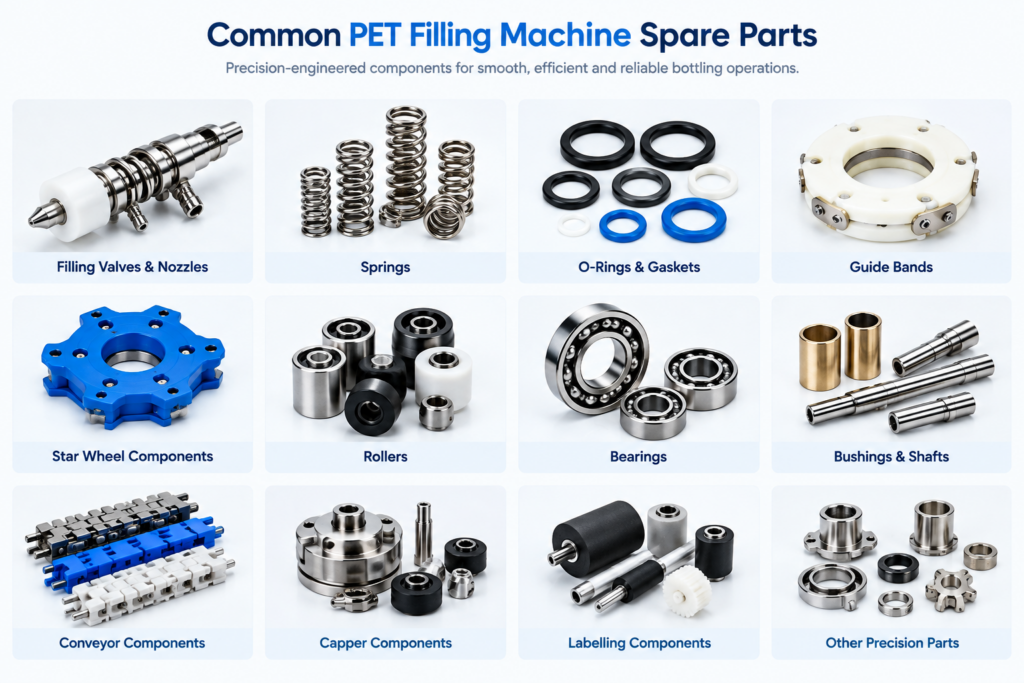
In a typical filling machine, different components perform specific functions. Filling valves control the flow of the product into the bottle, while filling nozzles and fill heads provide the required product delivery interface. O-rings, seals, and gaskets help maintain proper sealing between components and prevent unwanted leakage.
Other components are responsible for bottle movement and mechanical operation. Bottle grippers, clamps, star wheels, bottle holders, guide rails, bearings, bushings, shafts, pins, and rollers can be used to position, transfer, support, or guide bottles and machine assemblies during operation.
Filling machines can also contain pneumatic components, such as cylinders, solenoid valves, fittings, tubing, and flow-control components, which support automated movements. Sensors and switches can provide information related to bottle position, movement, pressure, or other machine conditions, allowing the control system to coordinate different stages of operation.
Depending on the machine configuration, spare parts may also be required for capping systems, conveyors, product-contact assemblies, and other integrated bottling-line equipment.
________________________________________________________________________________________________________________________
Major PET Bottle Filling Machine Spare Parts
PET bottle filling machines use a combination of mechanical, pneumatic, electrical, and product-contact components to maintain smooth and efficient production. Regular inspection and timely replacement of worn PET bottle filling machine spare parts can help reduce downtime, maintain filling accuracy, and improve overall machine reliability.
A. Filling Valves
Filling valves control the flow of liquid into bottles and are essential for consistent filling performance. Valve assemblies may include stems, seats, seals, springs, bushings, and other internal components. Worn valves can cause dripping, leakage, irregular filling, and production interruptions, making regular inspection important.
B. Filling Nozzles and Fill Heads
Filling nozzles and fill heads deliver the product into bottles in a controlled manner. Damage, contamination, or worn sealing surfaces can result in dripping, uneven flow, leakage, or filling inconsistencies. These components should be inspected regularly, especially where they come into contact with the product.
C. O-Rings, Seals and Gaskets
O-rings, seals, and gaskets help prevent leakage and maintain proper pressure within the filling system. Their material and dimensions should match the application and operating conditions. Cracking, swelling, hardening, deformation, or leakage are common indications that a seal may require replacement.
D. Bottle Grippers and Clamps
Bottle grippers and clamps securely hold and transfer bottles through different machine sections. Properly maintained grippers help maintain bottle stability, positioning, and smooth transfer. Worn or incorrectly adjusted components may lead to bottle slipping, misalignment, jams, or handling issues.
E. Bearings and Bushings
Bearings and bushings support moving and rotating machine components while reducing friction. Their condition can directly affect machine alignment, vibration, noise, and smooth movement. Unusual noise, heat, vibration, rough operation, or visible wear may indicate the need for inspection or replacement.
F. Pneumatic Components
Pneumatic components such as cylinders, solenoid valves, flow-control valves, fittings, tubing, and actuators support automated machine movements. Air leakage, slow movement, incomplete actuation, or unexpected stops may indicate a pneumatic system problem. Proper troubleshooting should include the complete air circuit.
G. Sensors
Sensors provide detection and position signals to the machine control system. Proximity, photoelectric, pressure, and level sensors may be used at different stages of the filling line. Incorrect sensor positioning, damage, or failure can result in bottle detection errors, machine stoppages, alarms, or sequence problems.
H. Capping Components
Capping systems use components such as capping heads, cap chucks, springs, cap guides, and torque-related parts. Properly maintained capping components help achieve consistent cap application. Worn or incorrectly adjusted parts may contribute to loose caps, excessive tightening, leakage, or cap-feeding problems.
I. Conveyor Components
Conveyor systems transport bottles between different stages of the production line. Common components include chains, belts, sprockets, guide rails, wear strips, rollers, and bearings. Regular maintenance helps prevent bottle instability, accumulation, excessive noise, and transfer interruptions.
________________________________________________________________________________________________________________________
How to Choose the Right Spare Parts for a PET Bottle Filling Machine ?
Selecting the right spare part is important for maintaining the performance, reliability, and safety of a PET bottle filling machine. A replacement component should not be selected only by appearance or price. Factors such as machine model, original part number, dimensions, material, operating conditions, compatibility, and required performance should be verified before placing an order.
1. Identify the Machine and Component
Start by identifying the machine manufacturer, model, machine type, and specific assembly where the replacement part will be installed. This helps narrow down the correct component and prevents compatibility issues.
2. Check the Original Part Number
The original part number is one of the most useful references when sourcing a replacement. Compare the part number with available supplier information and verify whether the replacement is intended for the same application.
3. Verify Dimensions and Specifications
Physical appearance alone is not enough. Check important specifications such as length, diameter, thread size, tolerances, mounting dimensions, operating range, and connection type. Even small dimensional differences can affect machine performance.
4. Confirm Material and Application Compatibility
Material selection is particularly important for seals, O-rings, gaskets, valves, and product-contact components. Consider factors such as product compatibility, temperature, pressure, cleaning chemicals, mechanical movement, and operating environment before selecting the material.
5. Consider OEM or OEM-Alternative Options
Depending on the application and sourcing requirements, plants may choose an OEM component or a properly engineered OEM-alternative part. For alternative parts, verify the supplier’s engineering specifications, manufacturing quality, compatibility, and inspection or testing practices.
6. Evaluate Supplier Quality
A reliable spare-parts supplier should be able to provide clear technical information and consistent manufacturing quality. Where necessary, ask about material specifications, dimensional accuracy, quality checks, part identification, and technical support.
7. Consider Operating Conditions
The same type of component may perform differently under different operating conditions. Consider the machine’s production speed, load, pressure, temperature, cleaning process, product type, and frequency of operation when selecting critical spare parts.
8. Check Availability and Lead Time
For critical components, availability is an important part of maintenance planning. Confirm the expected lead time and consider keeping frequently replaced parts in stock to reduce the impact of unexpected machine downtime.
9. Compare Total Value, Not Just Price
The lowest-priced component is not necessarily the most economical choice. Consider quality, expected service life, compatibility, maintenance requirements, availability, and potential downtime when comparing spare parts from different suppliers.
Quick Checklist Before Ordering
Before purchasing a PET bottle filling machine spare part, verify:
- Machine make and model
- Original part number
- Component dimensions
- Material specification
- Application and operating conditions
- Compatibility with the existing assembly
- Supplier quality and technical support
- Availability and lead time
- Required quantity
- Total maintenance value
Choosing spare parts based on these factors can help maintenance teams avoid incorrect replacements, reduce unexpected downtime, and maintain reliable filling-line performance.
________________________________________________________________________________________________________________________
OEM vs OEM-Alternative Spare Parts
When sourcing spare parts for PET bottle filling machines, manufacturers generally consider either OEM (Original Equipment Manufacturer) parts or OEM-alternative/compatible parts. The decision is not simply about purchase price. For a B2B bottling operation, factors such as machine compatibility, technical specifications, material quality, manufacturing consistency, lead time, documentation, technical support, and long-term maintenance requirements should also be considered.
| Factor | OEM Spare Parts | OEM-Alternative / Compatible Spare Parts |
|---|---|---|
| Source | Supplied by the original equipment manufacturer or its authorized supply chain | Supplied by an independent manufacturer or specialized spare-parts supplier |
| Design Reference | Based on the original machine design and specifications | Engineered with reference to the required application, dimensions, and specifications |
| Machine Compatibility | Intended for the specified OEM equipment | Must be verified against the machine and application |
| Part Number | Uses the original OEM part number | May use an equivalent/reference number for identification |
| Dimensions & Tolerances | Manufactured according to OEM requirements | Should be manufactured according to verified technical requirements |
| Material Specification | Defined by the OEM | Should be clearly specified and suitable for the application |
| Quality Control | Subject to the OEM’s manufacturing and inspection processes | Depends on the supplier’s manufacturing and quality-control system |
| Testing & Inspection | According to OEM processes and requirements | Depends on the supplier’s inspection and testing procedures |
| Documentation | Typically supported through OEM documentation | Documentation depends on the supplier |
| Traceability | Generally supported through the OEM supply chain | Depends on supplier systems and documentation |
| Availability | Depends on OEM inventory and distribution network | May provide an additional sourcing channel |
| Lead Time | Can vary depending on OEM production and stock | Can vary according to supplier capacity and stock |
| Technical Support | Available through OEM channels | Depends on the supplier’s technical expertise |
| Customization | Generally follows standard OEM specifications | Some suppliers may offer application-specific engineering |
| Procurement Flexibility | Tied to OEM supply arrangements | May provide an additional sourcing option |
| Purchase Cost | May be higher depending on the component and supply arrangement | May offer a different cost structure |
| Best Evaluation Criteria | OEM specification and supply requirements | Compatibility, engineering, quality, documentation, and supplier capability |
How Spare Parts Help Reduce Production Downtime
Production downtime can affect output, delivery schedules, maintenance costs, and overall equipment efficiency. In PET bottling operations, even the failure of a relatively small component can interrupt part of the filling or conveying process.
Keeping the right spare parts available helps maintenance teams respond to component failures more efficiently and restore equipment operation without unnecessary delays.
1. Faster Replacement of Worn Components
Components such as filling valves, seals, O-rings, bearings, bottle grippers, guide rails, and pneumatic parts can experience wear during continuous operation. Having suitable replacement parts available allows maintenance teams to replace worn components when required instead of waiting for sourcing and delivery.
2. Helps Prevent Extended Line Stoppages
A minor component failure can sometimes affect a larger machine assembly. For example, a damaged seal may cause leakage, while a worn bearing or bottle-handling component may affect machine movement or positioning.
Maintaining critical spare parts helps teams address these issues more quickly and minimize the duration of production interruptions.
3. Supports Preventive Maintenance
Spare parts are also important for planned maintenance. Frequently inspected wear components can be replaced based on their condition and maintenance requirements before they develop into more significant equipment problems.
4. Improves Spare-Part Availability
Bottling plants can identify critical, frequently replaced, and long-lead-time components and maintain appropriate stock levels. This gives maintenance and procurement teams greater control over replacement requirements.
5. Helps Maintain Consistent Machine Performance
Correctly specified replacement components help maintain the intended operation of individual machine assemblies. Components such as filling valves, nozzles, seals, bearings, grippers, and sensors can influence filling accuracy, bottle handling, movement, and machine sequencing.
6. Supports Better Maintenance Planning
Working with a reliable spare-parts supplier can make it easier to identify components using part numbers, machine details, drawings, dimensions, photographs, or samples. Accurate identification helps reduce the risk of ordering an unsuitable replacement and causing additional delays.
B2B Takeaway
For bottling plants, spare-parts management should be part of the overall maintenance and production strategy. Keeping the right components available, identifying wear early, and sourcing technically suitable replacements can help maintenance teams respond faster and reduce avoidable production downtime.
________________________________________________________________________________________________________________________
FAQs
Why Choose Vikram Solutions for PET Filling Machine Spare Parts?
For bottling plants, choosing a spare-parts supplier is about more than finding a replacement component. Technical suitability, manufacturing consistency, quality assurance, availability, and responsive support can all influence maintenance planning and machine performance.
Vikram Solutions specializes in OEM-alternative spare parts for PET blowing, filling, and labelling machines, combining engineering expertise with structured quality and global supply capabilities.
Engineering Expertise
Vikram Solutions has engineering roots dating back to 1988, with dedicated expertise in the bottling industry since 2016. This engineering background supports the development and supply of precision-engineered spare parts for bottling applications.
OEM-Alternative Spare Parts
Vikram Solutions supplies OEM-alternative spare parts under its own brand. The company states that its products are independently designed, manufactured, and supplied, while OEM part numbers and equipment references are used for identification and compatibility purposes.
Quality Assurance and Warranty
The company highlights a structured quality approach covering dimensional accuracy, material verification, performance validation, traceability, and post-delivery support. Spare parts supplied under the Vikram Solutions brand are also supported by defined quality assurance and warranty coverage.
Faster Part Identification
Identifying the correct spare part is often one of the first challenges for maintenance and procurement teams. Vikram Solutions provides an e-catalogue with part-number and reference-code search, while customers can also contact the team when a required part cannot be identified.
Structured Global Supply
Vikram Solutions highlights seven strategically located warehouses, real-time stock visibility, and air, sea, and door-to-door shipping to support both planned maintenance and urgent requirements.
Support Across Bottling Applications
The company supplies spare parts for PET blowing, filling, and labelling machines, along with components supporting glass and can-line applications. This allows industrial customers to source different bottling-line requirements through one specialized supplier.
Technical Support for Specific Requirements
When a part number is unavailable, customers can provide machine details, drawings, dimensions, photographs, or other technical information to help the team identify the required component.
A B2B-Focused Spare-Parts Partner
For maintenance, engineering, and procurement teams, Vikram Solutions offers more than individual replacement components. Its combination of engineering experience, OEM-alternative manufacturing, quality processes, part-identification support, warranty coverage, and global supply infrastructure provides a structured approach to sourcing PET filling machine spare parts.
Related Products
- Labeller Suction Rails & Cutting Knives
- PEEK Parts
- Bellows
- Mandrels & Preform Pickups
- Sealing Components
- Anti-Rotation Systems for Cappers
- Grippers & Gripper Assemblies
Contact Vikram Solutions
Keeping the right spare parts available is essential for maintaining reliable bottling operations and responding quickly to maintenance requirements. Vikram Solutions supplies precision-engineered OEM-alternative spare parts for PET filling, blowing, labelling, glass, and can line equipment.
Whether you need a replacement filling valve, nozzle, seal, bottle holder, bearing, pneumatic component, or another machine part, share your part number, machine model, drawing, dimensions, photograph, or sample with our team.
Contact us today or Request a quotation to discuss your requirements. We are committed to delivering reliable products, technical support, and timely service for your bottling operations.
Email: sales@vikramengineering.com
Phone: +91 97378 72978 | +91 84690 14508