
Bottle grippers are important components in automated bottling and packaging systems because they help hold, guide, transfer, or position bottles and related components during machine operation. Although a gripper may be a relatively small component compared with the overall machine, its condition and compatibility can have a direct effect on bottle handling, transfer accuracy, machine stability, and production continuity.
When a bottle gripper becomes worn, damaged, incorrectly adjusted, or improperly matched to the machine, maintenance teams may experience bottle slipping, inconsistent transfer, misalignment, recurring jams, increased rejection, or unplanned production interruptions.
For this reason, selecting the correct bottle gripper replacement is not simply a matter of finding a component that looks similar to the existing part. The replacement should be evaluated against the machine configuration, original part information, dimensions, mounting arrangement, bottle specifications, material requirements, and operating conditions.
This guide explains the main types of bottle grippers, common wear and failure signs, replacement considerations, compatibility checks, and practical steps for identifying the correct bottle gripper spare parts for bottling machinery.
Table of Contents
What is a Bottle Gripper?
A bottle gripper is a mechanical component used in automated bottle-handling systems to hold, guide, control, or transfer a bottle or bottle-related component during a specific stage of machine operation.
Depending on the machine design, a gripper may interact with the bottle neck, finish, body, or another defined gripping area. Its primary purpose is to maintain controlled positioning while the bottle moves between different machine stations or handling mechanisms.
Bottle grippers can be found in different types of bottling and packaging equipment, including systems involved in bottle transfer, handling, filling, labelling, and other automated processes.
The exact design of a gripper varies according to the machine, application, bottle configuration, mounting arrangement, and operating requirements.
A bottle gripper should therefore be treated as a precision machine component rather than a universal replacement item.
How Does a Bottle Gripper Work?
The basic operating sequence can be understood as:
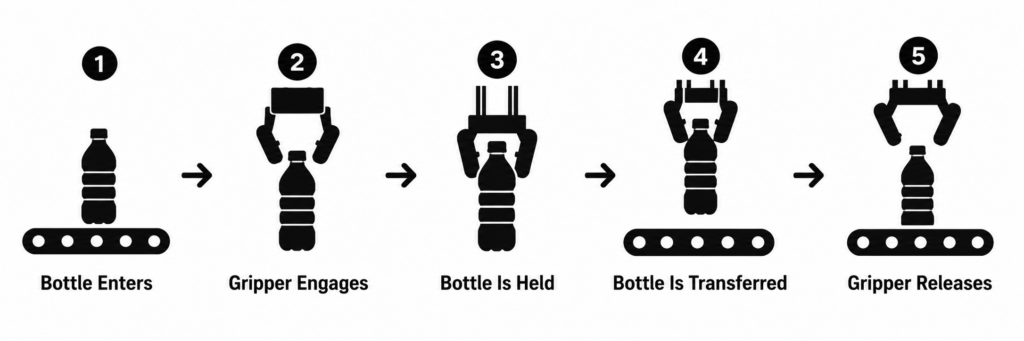
During operation, the gripper repeatedly opens and closes or engages and releases according to the machine’s mechanical movement.
Several factors are important for reliable operation:
Gripping Force
The gripper needs to hold the bottle securely without creating unsuitable mechanical loading. Excessive or insufficient gripping force can affect handling performance.
Bottle Positioning
Accurate positioning helps the bottle remain correctly aligned as it moves through the machine.
Transfer Accuracy
During high-speed automated operation, even relatively small positioning problems can affect the transfer between machine components.
Repeated Opening and Closing
Bottle grippers can operate through a large number of repeated cycles. Continuous mechanical movement can eventually contribute to wear of gripping surfaces, mounting areas, or related components.
Interaction With Other Components
A gripper does not operate independently. It may work together with guides, transfer mechanisms, rails, clamps, starwheels, shafts, bearings, or other machine components.
Therefore, a problem that appears to be a gripper failure may sometimes involve alignment, mounting, adjustment, or another related component.
Types of Bottle Grippers
Bottle grippers are available in different configurations depending on the machine and application. The exact design should always be verified against the specific equipment before ordering a replacement.
1. Mechanical Bottle Grippers
Mechanical bottle grippers use a physical gripping mechanism to hold and control the bottle during handling or transfer.
Their design can include moving gripping elements that engage with a defined area of the bottle or component.
Typical considerations include:
- Gripping geometry
- Mechanical movement
- Contact surface
- Mounting configuration
- Required gripping force
- Bottle dimensions
- Machine operating conditions
Mechanical grippers can be highly application-specific, so dimensional compatibility is important when selecting replacement parts.
2. Neck Grippers
Neck grippers hold the bottle around the neck or finish area.
This type of gripping arrangement requires careful consideration of bottle-neck dimensions because the contact geometry must correspond with the application.
Important factors can include:
- Neck diameter
- Neck finish configuration
- Contact area
- Gripping position
- Bottle size
- Gripper dimensions
- Clearance from surrounding components
A replacement neck gripper that appears visually similar may still be unsuitable if its gripping geometry or dimensions differ from the required configuration.
3. Clamp-Type Grippers
Clamp-type grippers use a clamping action to hold the bottle or component in a controlled position.
Compatibility may depend on:
- Clamp dimensions
- Opening range
- Mounting arrangement
- Contact surfaces
- Bottle geometry
- Machine movement
- Operating conditions
Before selecting a replacement, the complete mounting and operating configuration should be checked rather than relying only on appearance.
4. Machine-Specific Gripper Designs
Many bottling machines use application-specific gripper designs.
Differences can exist in:
- Overall dimensions
- Mounting holes
- Mounting orientation
- Contact geometry
- Material
- Operating clearance
- Bottle-handling position
- Mechanical interface
This is why identifying the original part number, machine configuration, drawing, dimensions, or physical sample can significantly improve replacement accuracy.
Common Bottle Gripper Wear and Failure Signs
Bottle gripper wear may develop gradually and may initially appear as a small handling problem. If the underlying issue is not addressed, however, it can contribute to repeated production interruptions or component damage.
The following signs can indicate that a bottle gripper requires inspection.
| Wear or Fault Sign | Possible Cause | Potential Effect |
|---|---|---|
| Bottle slipping | Worn gripping surface | Poor or inconsistent transfer |
| Inconsistent gripping | Wear or incorrect adjustment | Bottle misalignment |
| Cracks or deformation | Mechanical stress or wear | Reduced gripping reliability |
| Excessive movement | Loose or worn components | Transfer instability |
| Increased bottle rejection | Poor positioning | Production losses |
| Frequent jams | Incorrect gripping or alignment | Line interruption |
| Unusual mechanical noise | Worn related components | Possible component failure |
These symptoms should not automatically be attributed to the gripper alone. Alignment, mounting, adjustment, bottle dimensions, and related machine components should also be checked during troubleshooting.
What Causes Premature Bottle Gripper Wear?
Bottle grippers operate under repeated mechanical cycles, and several factors can contribute to premature wear.
Continuous Machine Operation
Long operating periods can increase the number of gripping cycles experienced by the component.
Repeated Gripping Cycles
Frequent opening, closing, engagement, and release can gradually affect contact surfaces and moving interfaces.
Incorrect Alignment
Misalignment can create uneven loading and affect the way the gripper interacts with the bottle.
Incorrect Gripping Force
If the gripping force is unsuitable for the application, the component may not perform as intended.
Improper Installation
Incorrect mounting, positioning, or assembly can affect the operation and service life of the gripper.
Contamination
Dust, residue, product contamination, or other foreign material may interfere with mechanical movement or contact surfaces.
Mechanical Impact
Unexpected impacts or abnormal machine movement can cause deformation, cracks, or accelerated wear.
Incorrect Replacement Dimensions
A replacement component with incorrect dimensions can create additional mechanical stress or poor bottle positioning.
Unsuitable Material
The material should be appropriate for the operating conditions and application requirements.
Poor Maintenance
Insufficient inspection and delayed replacement of worn components can allow minor problems to develop into larger machine issues.
When Should You Replace a Bottle Gripper?
There is no universal replacement interval that applies to every bottle gripper.
Replacement decisions should instead be based on the component’s actual condition, operating environment, machine requirements, and maintenance history.
A practical maintenance approach is:
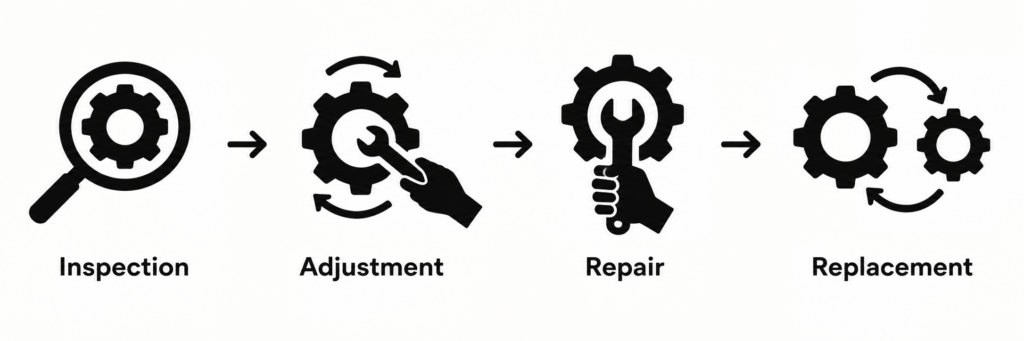
Inspection
First inspect the gripper for:
- Visible cracks
- Deformation
- Surface wear
- Loose mounting
- Excessive movement
- Abnormal contact marks
- Damage around mounting points
Adjustment
If the component itself is in acceptable condition, incorrect alignment or adjustment may sometimes be responsible for the observed problem.
Repair
Where technically appropriate, certain related components or mounting arrangements may be repairable.
Replacement
Replacement should be considered when the gripper has significant wear, visible damage, dimensional deterioration, recurring operating problems, or can no longer maintain the required gripping performance.
Common replacement indicators include:
- Repeated bottle slipping
- Inconsistent bottle transfer
- Recurring machine jams
- Visible deformation
- Cracks or physical damage
- Excessive mechanical movement
- Increased bottle rejection
- Repeated maintenance problems
- Inability to maintain the required gripping position
How to Choose the Correct Bottle Gripper Replacement
Selecting the correct bottle gripper replacement requires more than matching the general shape of the existing component.
The following information can help maintenance and procurement teams identify the appropriate replacement.
1. Machine Manufacturer and Model
Record the machine manufacturer, machine model, and relevant machine section whenever available.
This helps establish the application in which the gripper is installed.
2. Original Part Number
The original part number is one of the most useful references for identifying a replacement.
Where possible, provide the complete part number exactly as marked on the original component, drawing, spare-parts list, or machine documentation.
3. Bottle Neck or Finish Dimensions
For grippers that interact with the bottle neck or finish, the relevant bottle dimensions should be verified.
Important measurements may include:
- Neck diameter
- Finish dimensions9
- Contact area
- Bottle opening configuration
- Applicable bottle size
4. Gripper Dimensions
Measure the existing component where possible.
Useful dimensions can include:
- Overall length
- Overall width
- Thickness
- Opening dimensions
- Hole spacing
- Contact geometry
- Critical radii or profiles
5. Mounting Configuration
Check how the gripper is mounted to the machine.
Consider:
- Mounting holes
- Hole diameter
- Hole spacing
- Fastener arrangement
- Mounting orientation
- Mounting interface
6. Material
Material selection can influence durability, compatibility, and operating performance.
The replacement material should be suitable for the application and operating environment.
7. Operating Conditions
Consider the actual environment in which the component operates.
Relevant factors may include:
- Machine speed
- Operating temperature
- Moisture
- Cleaning conditions
- Product environment
- Mechanical loading
- Continuous or intermittent operation
8. Bottle Type and Size
Bottle design can affect the required gripping configuration.
Provide the bottle type and relevant dimensions whenever possible.
9. Technical Drawing
A technical drawing can provide information that may not be visible from a photograph.
Drawings are particularly useful when several similar components have different dimensions or mounting configurations.
10. Existing Part or Physical Sample
If the original part number is unavailable, a photograph, dimensional sketch, or physical sample can help with identification.
A sample can provide useful information about:
- Shape
- Dimensions
- Mounting
- Contact surfaces
- Material
- Wear pattern
Replacement Identification Checklist
Before ordering a replacement bottle gripper, provide:
- Original part number
- Machine manufacturer
- Machine model
- Machine section or application
- Bottle type
- Bottle-neck or finish dimensions
- Gripper dimensions
- Mounting information
- Technical drawing, if available
- Clear photographs
- Physical sample details
- Required quantity
The more technical information available, the easier it is to evaluate replacement compatibility.
Bottle Gripper Compatibility: What Should You Check?
Compatibility is one of the most important considerations when purchasing bottle gripper spare parts.
A component that looks similar to the original does not necessarily mean it is compatible.
Before ordering, evaluate the following:
Dimensional Compatibility
Confirm that the replacement matches the required dimensions and critical tolerances.
Mounting Compatibility
Check mounting holes, interfaces, orientation, fasteners, and available clearance.
Bottle-Neck Compatibility
For neck-gripping applications, confirm that the contact geometry corresponds to the bottle neck or finish.
Machine-Model Compatibility
The replacement should be evaluated against the specific machine configuration rather than only the general machine category.
Material Suitability
Confirm that the material is appropriate for the application and operating environment.
Operating Environment
Consider temperature, moisture, cleaning conditions, mechanical loading, and operating cycles.
Gripping Position
The replacement must hold the bottle at the intended position.
Clearance With Surrounding Components
Check that the replacement does not interfere with adjacent machine components during operation.
OEM vs OEM-Alternative Bottle Grippers
When sourcing replacement components, maintenance and procurement teams may consider either an original equipment manufacturer (OEM) part or an OEM-alternative component.
| Factor | OEM Part | OEM-Alternative Part |
|---|---|---|
| Source | Original equipment manufacturer | Specialist alternative supplier |
| Identification | OEM reference | Part number, drawing, dimensions, sample, or application |
| Compatibility | Based on original specification | Requires technical verification |
| Selection | Original equipment specification | Engineering-based replacement |
| Procurement | Original equipment supply channel | Alternative sourcing channel |
An OEM-alternative component should not be selected solely because its appearance is similar to an original part. Technical information should be evaluated to establish whether the replacement is suitable for the intended application.
The objective should be accurate identification and compatibility rather than simply finding the closest-looking component.
How to Verify a Bottle Gripper Before Ordering
A structured verification process can reduce the risk of receiving an incorrectly matched spare part.
Step 1: Identify the Machine
Record the machine manufacturer, model, and relevant machine section.
Step 2: Record the Original Part Number
Check the component, drawing, spare-parts list, or existing documentation for the complete reference.
Step 3: Record Critical Dimensions
Measure the important dimensions of the existing gripper.
Step 4: Check Bottle-Neck Specifications
Where applicable, record the bottle neck or finish dimensions.
Step 5: Check the Mounting Arrangement
Compare mounting holes, interfaces, orientation, and fasteners.
Step 6: Review Drawings and Photographs
Provide technical drawings and clear photographs where available.
Step 7: Confirm Material
Check the required material and operating environment.
Step 8: Confirm Quantity
Specify the number of components required for the maintenance or production requirement.
Step 9: Request Technical Confirmation
Where there is uncertainty, provide the available technical information to the spare-parts supplier for evaluation.
Step 10: Proceed With Quotation or Order
Once the component information and compatibility requirements have been reviewed, proceed with the quotation or purchase process.
Bottle Gripper Maintenance Tips
Preventive inspection can help identify wear before it develops into a larger machine-handling problem.
Maintenance teams should consider the following practices:
Inspect Gripping Surfaces Regularly
Look for excessive wear, surface damage, deformation, or unusual contact patterns.
Check Mounting Points
Loose or damaged mounting arrangements can affect positioning and machine stability.
Monitor Bottle Slipping
Repeated bottle slipping can indicate a problem with the gripper, adjustment, alignment, or another related component.
Check Alignment
Confirm that the gripper remains correctly aligned with the intended bottle path and machine mechanism.
Keep the Mechanism Clean
Remove contamination that may interfere with movement or contact surfaces, following the machine manufacturer’s applicable maintenance procedures.
Replace Damaged Components Promptly
Continuing to operate with visibly damaged or severely worn components can contribute to additional machine problems.
Record Recurring Failures
Document repeated failures, replacement frequency, operating conditions, and affected machine sections. This information can help maintenance teams identify recurring issues and improve spare-parts planning.
How Vikram Solutions Can Help With Bottle Gripper Replacement
Vikram Solutions provides OEM-alternative spare-part solutions for bottling and packaging machinery.
When a bottle gripper requires replacement, accurate part identification is an important part of the sourcing process. Customers can provide the original part number, machine model, technical drawing, dimensions, photographs, physical sample information, or application details to help determine the appropriate replacement solution.
Vikram Solutions focuses on precision-engineered spare parts for bottling operations and supports customers with technical and commercial enquiries for replacement components.
For buyers and maintenance teams, providing complete technical information can make the identification and quotation process more efficient.
Need a Bottle Gripper Replacement?
When requesting a bottle gripper quotation, provide the following information whenever available:
- Part number
- Machine manufacturer and model
- Machine section or application
- Technical drawing
- Critical dimensions
- Bottle specifications
- Clear photographs
- Existing sample details
- Required quantity
Providing these details helps establish the technical requirements before proceeding with a replacement.
Request a Quotation for Your Bottle Gripper
If you are looking for bottle gripper spare parts or need assistance identifying a replacement component, share your available part information and application details with Vikram Solutions.
Accurate Identification. Reliable Replacement. Better Bottling Operations.
Frequently Asked Questions (FAQs) About Bottle Gripper Replacement
Conclusion
Bottle grippers play an important role in controlled bottle handling and transfer within automated bottling systems. Because these components can operate through repeated mechanical cycles, wear, incorrect adjustment, alignment problems, or unsuitable replacement dimensions can affect machine performance.
When a bottle gripper needs replacement, selecting the correct component requires more than visual similarity. Part number, machine configuration, dimensions, mounting arrangement, bottle specifications, material, operating conditions, and technical documentation should all be considered.
A structured identification and compatibility-checking process can help maintenance and procurement teams reduce the risk of selecting an unsuitable component and support more reliable spare-parts planning.
For bottle gripper replacement requirements, providing complete technical information—including the part number, machine model, drawings, dimensions, photographs, or sample details—can help streamline the identification and quotation process.
Looking for bottle gripper spare parts? Contact Vikram Solutions with your part details and application requirements.
Email: sales@vikramengineering.com
Phone: +91 97378 72978 | +91 84690 14508
